How to Use Customer Lifetime Value (LTV) to Increase Revenue and Conversion Rates
Building Customer Relationships Starting with Customer Lifetime Value (LTV)
Customer Lifetime Value (LTV) refers to the total value a customer is expected to generate throughout their entire relationship with a business. By leveraging LTV, businesses can improve the customer experience, allocate marketing budgets more efficiently, and increase long-term revenue and customer loyalty.
What Is Customer Lifetime Value (LTV)?
Customer Lifetime Value (LTV) is a metric that measures the total value a customer is expected to contribute to a business from their first purchase until the end of their relationship with the company.
Every time a customer purchases a product or uses a service, they generate revenue for the business. However, acquiring and retaining customers also involves costs, such as advertising expenses, promotional campaigns, and customer support.
For this reason, LTV is more than simply the total revenue generated by a customer. It is a metric that evaluates a customer’s true value by considering both the long-term revenue they generate and the costs required to acquire and retain them.
LTV is also commonly referred to as Customer Lifetime Value, or CLV. Businesses typically compare LTV with Customer Acquisition Cost (CAC) to evaluate the profitability of their customer acquisition strategies and the long-term growth potential of the business.
How Do You Calculate Customer Lifetime Value (LTV)?
There are several ways to calculate LTV, but one of the most common formulas is:
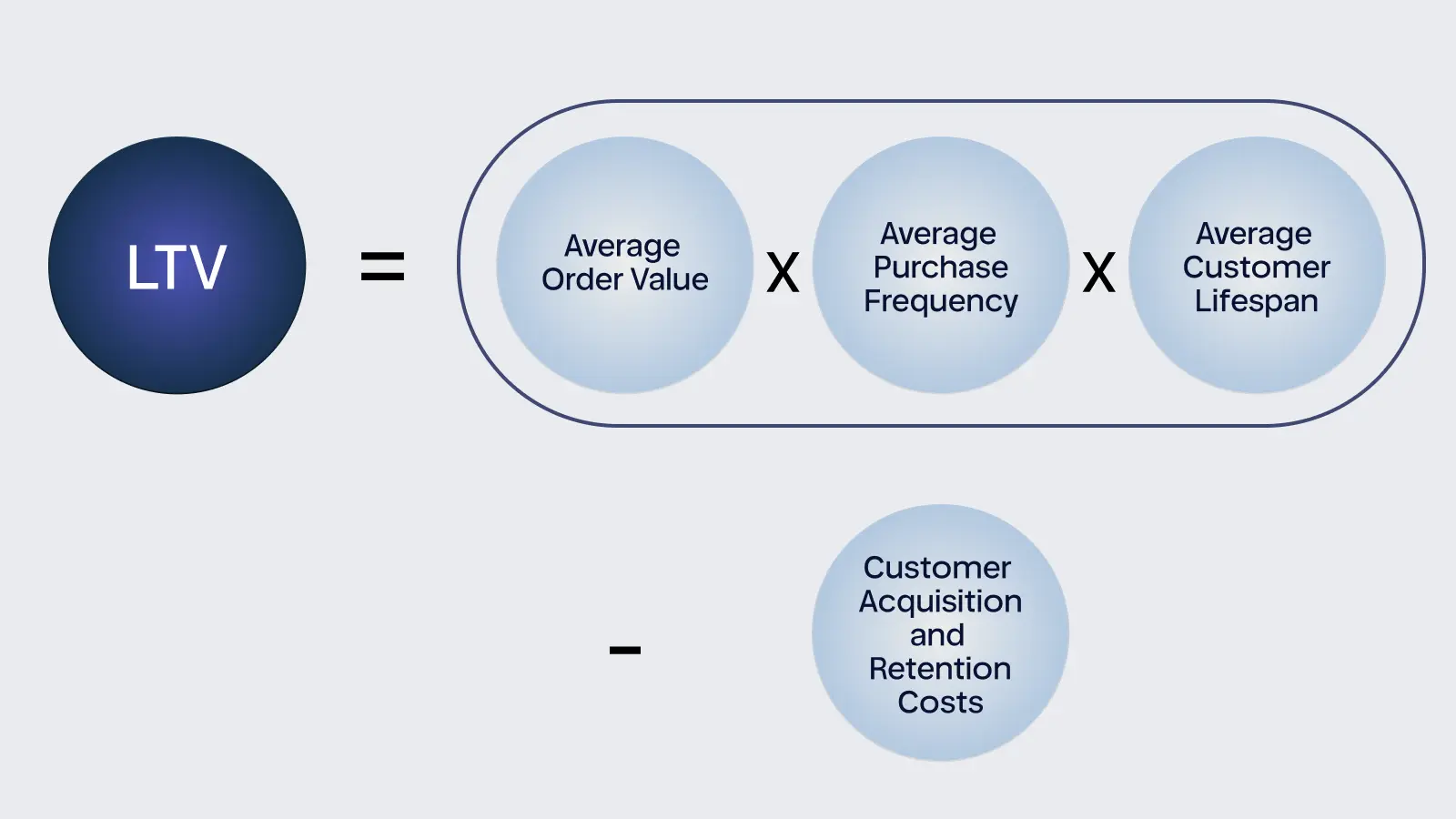
Key Components of the LTV Formula
- Average Order Value
The average amount a customer spends each time they make a purchase. - Average Purchase Frequency
The average number of purchases a customer makes over a given period. - Average Customer Lifespan
The average length of time a customer continues doing business with your company. - Customer Acquisition and Retention Costs
The total marketing, promotional, and customer management costs required to acquire and retain a customer.
For example, suppose a customer spends an average of $50 per purchase, makes one purchase each month, and remains a customer for an average of two years. If the total cost of acquiring and retaining that customer is $50, the LTV can be calculated as follows:
If the calculated LTV is sufficiently high, it means the customer generates more value than it costs to acquire and retain them.
On the other hand, if LTV is low or lower than the customer acquisition cost, it indicates that the business is not generating enough profit to justify its acquisition investment. In that case, the company should reassess its marketing and customer retention strategies.
Why Customer Lifetime Value (LTV) Matters
LTV measures more than a single purchase or short-term revenue. It reflects the long-term value a business can generate through an ongoing relationship with its customers.
By understanding customer LTV, businesses can develop strategies that go beyond short-term conversion rates and take into account repeat purchases, customer retention, average order value, and marketing efficiency.
Understanding Customer Value and Segmenting Customers
Not all customers create the same amount of value.
Some customers make a single purchase and never return, while others purchase repeatedly and recommend the brand to others. LTV helps businesses measure exactly how much value each customer contributes over time.
Based on LTV, businesses can segment customers into groups such as:
- High-value customers who currently generate significant revenue
- Customers with strong long-term growth potential
- Customers who need to increase their purchase frequency or average order value
- Customers whose profitability is low compared to the cost of retaining them
By identifying customers with high LTV, businesses can clearly determine who their VIP customers are and which customers deserve the greatest investment.
Conversely, rather than continuing to spend heavily on low-LTV customers, businesses should identify what prevents these customers from purchasing more frequently and look for ways to improve the customer experience or product offering to increase their lifetime value.
According to the Pareto Principle, the top 20% of loyal, repeat customers often account for approximately 80% of total revenue. This illustrates just how important it is to retain customers with high lifetime value.
Optimizing Your Marketing Budget
LTV is also an essential metric when deciding how to allocate a limited marketing budget. Once you know the average LTV of a customer, you can estimate how much you can reasonably spend to acquire a new customer.
For example, if your average customer has an LTV of $1,000, consistently spending more than $1,000 to acquire a single customer is unlikely to be profitable over the long term. LTV helps businesses establish an appropriate upper limit for customer acquisition costs while reducing excessive discounting and inefficient advertising spend.
Comparing LTV across acquisition channels also allows businesses to identify which channels bring in the most valuable customers over time, rather than simply generating the highest number of clicks or first-time purchases.
If customers acquired through a particular advertising campaign purchase more frequently and remain customers longer than those from other channels, allocating more budget to that campaign can improve overall marketing efficiency.
Evaluating Long-Term Business Sustainability
A high customer retention rate does not necessarily mean a business is highly profitable. Even if customers remain with a company for a long time, profitability may still be limited if they spend very little or if the cost of retaining them is too high.
For this reason, businesses should evaluate not only customer retention but also the actual revenue each customer generates.
A high LTV indicates that customers are likely to stay with the brand longer, make repeat purchases, and gradually increase their spending. Loyal customers may also purchase additional products and recommend the brand to others, bringing in new customers through referrals.
As the number of high-LTV customers grows, businesses can forecast revenue more accurately and build a stronger foundation for launching new products or expanding into new markets.
Conversely, if a business continues to attract only low-LTV customers, revenue may increase temporarily, but high marketing costs and low repeat purchase rates can ultimately undermine the long-term sustainability of the business.
Strategies to Increase Customer Lifetime Value
To increase LTV, businesses need to move beyond a model where customers make a single purchase and never return.
1. Improve the Customer Experience
Customer experience is the foundation of increasing LTV. When customers can easily find the products and information they need on a website or app and complete their purchases without frustration, they are more likely to return and make repeat purchases—not just complete their first purchase.
Build an Intuitive and Efficient Store
In an online store, even small inconveniences can lead to abandoned purchases. If pages load slowly, product information is incomplete, buttons are difficult to tap on mobile devices, or the checkout process is complicated, customers may abandon their purchase even if they are interested in the product.
Store owners should regularly evaluate whether:
- The product’s value is communicated clearly above the fold
- Customers can easily find the product information they need
- Product options and pricing are presented clearly
- The purchasing process is seamless on mobile devices
- Shipping, return, and payment information is placed where customers expect to find it
- Customers can easily determine the next step in the buying process
Improving these elements reduces friction throughout the purchase journey and helps increase conversion rates.
Recently, more businesses have started using AI to optimize their online stores. Instead of relying solely on manual analysis, AI can browse a store like a real customer, analyze the shopping experience, identify conversion barriers, and recommend opportunities for improvement.
The Shopify app Gentoo is one example. Using User Clones, Gentoo simulates real customer shopping journeys and automatically identifies factors that may reduce conversions. It analyzes areas such as storefront UX, product content, mobile experience, SEO, and email campaigns, then recommends actionable improvements that merchants can either approve manually or deploy automatically.
By continuously monitoring and improving the store experience, businesses can make it easier for customers to understand products and complete purchases. A positive shopping experience encourages repeat visits and repeat purchases, ultimately increasing Customer Lifetime Value (LTV).
Provide Fast and Friendly Customer Support
Responding quickly to customer questions and complaints is equally important. When problems arise, customers are more likely to trust a brand if the business resolves the issue clearly, promptly, and courteously.
A positive customer support experience can turn a dissatisfied customer into a loyal one. On the other hand, even a small unresolved issue may become the reason a customer never returns.
Collect and Act on Customer Feedback
To understand where customers experience friction, businesses should collect feedback on a regular basis.
Surveys, customer inquiries, reviews, and behavioral data all provide valuable insights into customer needs and pain points. These insights should be reflected in ongoing store improvements.
Being transparent about improvements and product updates also shows customers that their feedback is valued, strengthening trust in the brand.
2. Deliver Personalized Experiences
Personalization is a strategy that increases purchase likelihood and customer loyalty by providing experiences tailored to each customer’s interests and needs.
By using previous purchase history, product interests, acquisition channels, preferred categories, and behavioral data, businesses can deliver relevant content and offers instead of showing every customer the same message.
Common personalization strategies include:
- Recommending products related to previous purchases
- Delivering content based on customer interests
- Sending emails at the right stage of the customer journey
- Offering benefits based on customer tier or activity
- Following up based on shopping cart activity and browsing behavior
However, personalization goes beyond simply recommending different products. Improving the store itself by analyzing where customers leave, what information is missing, and which parts of the shopping experience make purchase decisions more difficult is also part of creating a personalized customer experience.
When customers receive the information they need at the right moment and encounter fewer obstacles during the buying process, they are more likely to feel that the brand understands their needs.
3. Offer Membership Benefits
Membership programs are one of the most effective strategies for increasing LTV by encouraging customer loyalty and repeat purchases. By creating membership tiers based on purchase value or customer activity and offering different benefits for each tier, businesses can naturally encourage customers to continue purchasing in order to unlock greater rewards.
Membership benefits may include:
- Tier-based discount coupons
- Additional reward points based on purchase amount
- Free shipping
- Early access to new products
- Members-only events
- Exclusive products or content
A membership program should do more than simply offer discounts. It should make customers feel like valued members of the brand’s community.
At the same time, the program should remain easy to understand. Overly complicated tier structures or difficult-to-use benefits can discourage participation, so rewards should be designed to be simple and accessible.
4. Launch a Rewards Program
A rewards program provides customers with points, mileage, or other incentives whenever they make a purchase or complete specific actions. Customers are encouraged to purchase again or engage with the brand in order to earn rewards, increasing both purchase frequency and customer retention over time.
Rewards can be offered for many different activities, including:
- Creating an account
- Making a first purchase
- Writing a review
- Referring a friend
- Subscribing to a newsletter
- Sharing on social media
- Spending above a certain purchase amount
The key is ensuring that customers perceive the rewards as genuinely valuable.
Points that are difficult to redeem or rewards that require unrealistic conditions are unlikely to encourage participation. Businesses should establish clear and achievable reward criteria so customers can experience the benefits within a reasonable period.
LTV Strategies Should Be Continuously Optimized
Improving the customer experience, optimizing the store, personalizing the shopping journey, and implementing membership and rewards programs all help increase customer satisfaction, encourage repeat purchases, and ultimately improve Customer Lifetime Value.
However, not every strategy produces the same results for every business.
Store owners should continuously use customer data to answer questions such as:
- Which customer segments have the highest LTV?
- Which acquisition channels bring in the highest-LTV customers?
- At which stage of the buying journey do customers drop off most often?
- Which products and experiences encourage repeat purchases?
- Which benefits actually lead to higher purchase rates?
- How have optimization efforts affected conversion rates and revenue?
Answering these questions requires more than simply analyzing customer data. Businesses must also translate those insights into meaningful improvements to their online stores.
For Shopify stores in particular, product content, purchasing UX, mobile experience, SEO, and email marketing all work together to influence purchasing decisions.
Rather than relying on one-time redesigns or short-term marketing campaigns, businesses should establish an ongoing process for continuously evaluating and improving the customer experience.
Look Beyond Short-Term ROAS and Focus on Long-Term Customer Value
Businesses that achieve sustainable growth in a competitive market aren’t simply the ones that acquire the most new customers. They’re the ones that keep customers coming back, encourage repeat purchases, and turn satisfied shoppers into loyal advocates.
A high Customer Lifetime Value means each customer generates more revenue and profit over time, giving your business a stronger foundation to withstand rising advertising costs and changing market conditions.
As a marketer, it’s important to look beyond short-term ROAS and first-purchase conversion rates. You should also measure how long customers stay, how often they purchase, and the value they generate throughout their relationship with your brand.
Increasing LTV isn’t just about offering more promotions. It’s about continuously identifying and removing the friction that customers experience throughout the buying journey.
Today, AI-powered Shopify apps such as Gentoo make this process much easier. By continuously analyzing your storefront based on real shopper behavior, these tools can uncover growth opportunities, improve the shopping experience, and help increase both conversion rates and Customer Lifetime Value over time.
If you’d like to learn more about how Gentoo works, explore it on the Shopify App Store.