On this page
Shopify Store Audit vs Continuous Optimization: Which Approach Fits Your Growth Stage?
Compare a standalone Shopify store audit with continuous optimization. Learn how to turn findings into owned actions and measured outcomes.

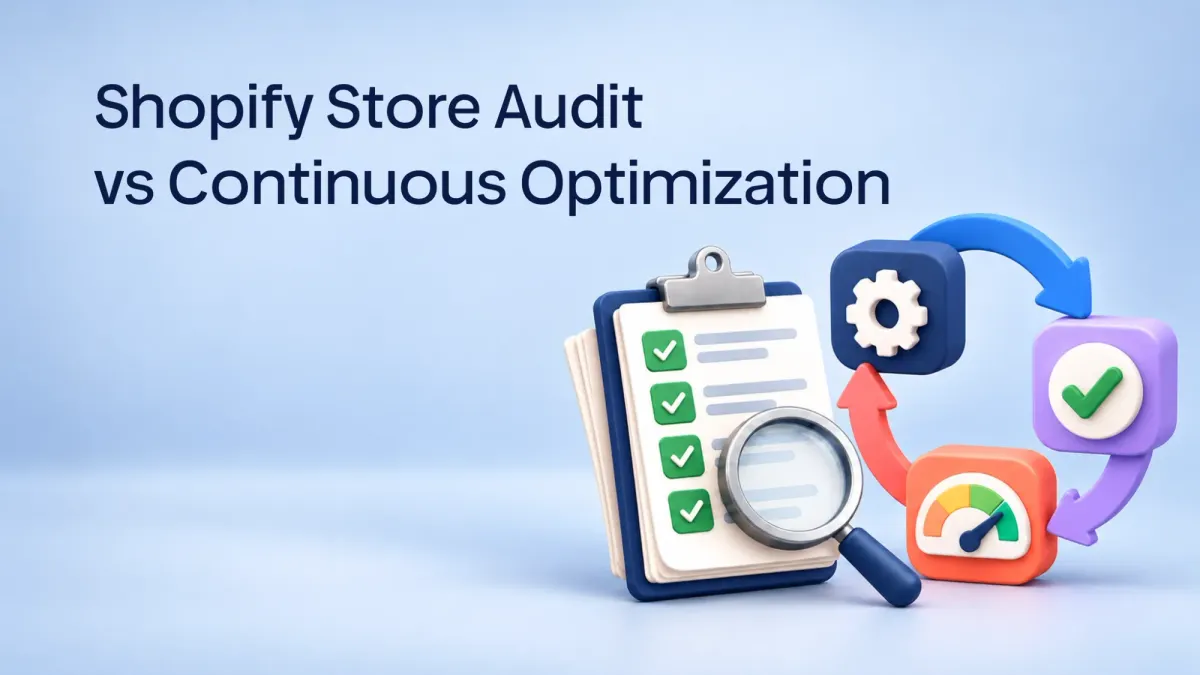
A Shopify store audit can reveal usability, SEO and conversion problems. Continuous optimization goes further: choose the improvement that fits the merchant's goal and limits, carry it out, and use the business result to decide what comes next.
A standalone audit captures the store at a point in time. Follow-through needs an owner for priorities, approvals, implementation and learning. Some agencies include that work in their service; an audit-only deliverable does not.
For a busy merchant, the difference is practical: who will bring back the next decision, explain why it matters and report what happened without waiting to be asked?
What a Shopify store audit does well
A good audit creates a shared view of the store. It can help a team:
- Find visible usability problems
- Check technical and SEO foundations
- Review product pages and collection structure
- Identify trust and policy gaps
- Compare the store with competitors
- Build an initial list of possible improvements
Audits are especially useful when a store is new, a theme has changed, a large catalog has been reorganized, or a team needs an outside perspective. The problem is not the audit. The problem is treating the audit as the complete growth process.
Where a static audit stops
An audit often produces a list of recommendations. The list may be accurate and still fail to create change. A recommendation can remain unfinished because:
- The team does not know which item is most important.
- The issue is connected to a larger journey problem.
- Implementation requires coordination across theme, apps, operations, or content.
- The store's business goal changed.
- The team made a change but did not measure the result.
- A visible issue was not the real reason shoppers were leaving.
For example, “improve product navigation” may be correct, but it does not answer which category to change first, what evidence supports the change, or how success should be measured.
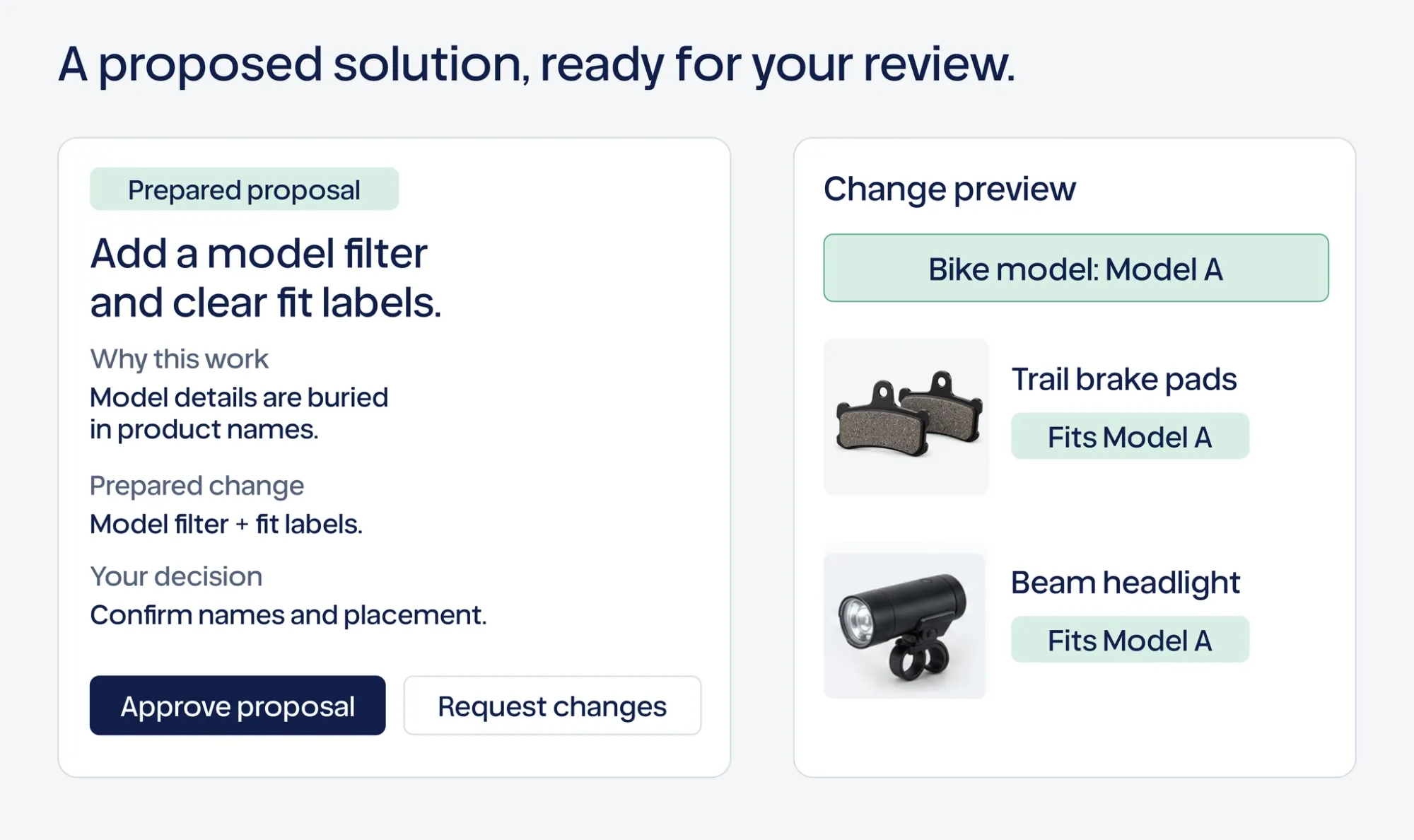
Turn an audit finding into a work item
“Improve navigation” is not enough to start work. A useful handoff identifies the affected collection, the evidence, the proposed change, the owner, and the success measure.
For a bike-parts collection, that might be: “Shoppers cannot narrow results by bike model. Confirm the catalog attributes, add a usable model filter, and track whether more shoppers reach relevant product pages and complete an order.” This is an example work item, not a promised result.
If the audit does not include implementation, ask who will do that work before commissioning another report.
What continuous optimization adds
Continuous optimization turns observations into work and then learning. It also needs someone to keep the process moving: bring forward the next recommendation, get a decision and return with the result.
That responsibility can sit with your team, an agency or a growth partner. Adding a recurring report does not, by itself, remove the merchant's decision-making burden.
A practical loop includes:
- Define the business outcome.
- Understand the merchant's operating limits, business guidelines and category context.
- Investigate store and shopper signals.
- Prioritize the opportunity with the highest expected value.
- Approve and implement an action.
- Measure the business outcome.
- Use the business outcome to revise the next priority.
This process accepts that the right answer depends on the store. One merchant may need to improve product information. Another may need to simplify navigation. Another may need to reduce checkout uncertainty or improve search visibility. There is no universal order of operations.
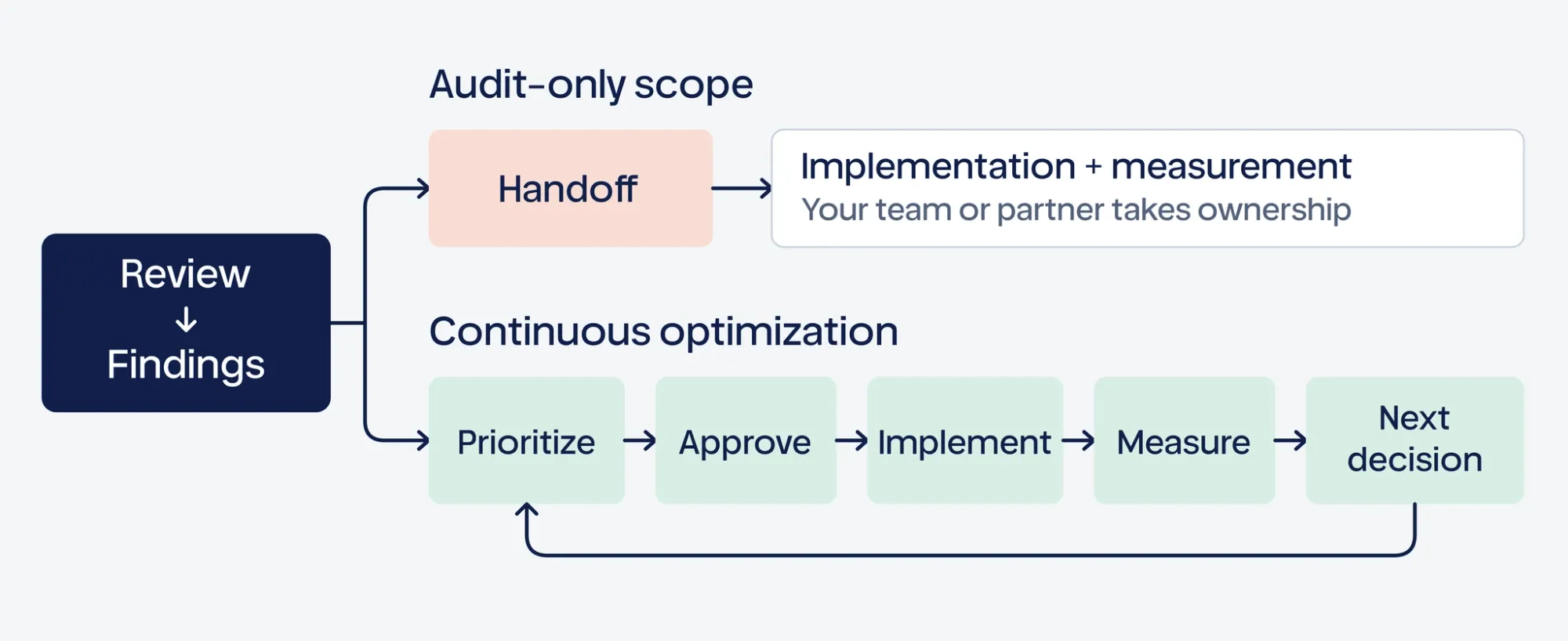
Audit versus continuous optimization
The difference is easiest to see by looking at what happens after the observation.
Standalone audit deliverable
- Review the store
- Document issues
- Deliver recommendations
- Hand off implementation and measurement unless they are included in the engagement
Continuous optimization model
- Review the store in relation to a business goal
- Identify and rank opportunities
- Agree on the next action
- Implement the change
- Measure its business impact
- Recalibrate the next priority
An audit can be the first step in both models. Continuous optimization adds the work required to turn findings into learning.
How to choose the right approach
A Shopify store audit may be the right starting point when:
- You need a baseline before a redesign.
- You are launching a new store or theme.
- You need a technical or SEO health check.
- You want to understand obvious gaps.
- You have the internal capacity to prioritize and implement.
Continuous optimization may be a better fit when:
- The store already has traffic and sales data.
- Many possible issues compete for attention.
- The business goal is clear but the next action is not.
- Previous audits have produced recommendations without enough follow-through.
- You need to connect changes to conversion, revenue, margin, or retention.
- The store changes often and needs ongoing calibration.
A hybrid approach can also make sense. Use an audit for broad coverage, then use continuous optimization to decide what to act on and learn from.
The role of CRO and testing
Continuous optimization is not the same as running random A/B tests. A test is one possible action. It should follow an informed question about a meaningful opportunity. Before testing, clarify:
- What behavior suggests a problem?
- What change might address it?
- Which shoppers are affected?
- What outcome should move?
- What guardrails protect margin, trust, or customer experience?
Sometimes the best action is a test. Sometimes it is a navigation change, clearer product content, a technical fix, or a new measurement step.
What to compare when evaluating vendors
When comparing an audit, an agency, software, or an AI growth agent, ask:
- Does it only identify issues, or does it help move work forward?
- Can it connect recommendations to a business goal?
- Does it account for merchant context and constraints?
- Who owns implementation?
- How are changes measured?
- How does the system learn from outcomes?
- Who brings decisions and results back to the merchant, and what remains under their control?
These questions are more useful than counting the number of checks in a report.
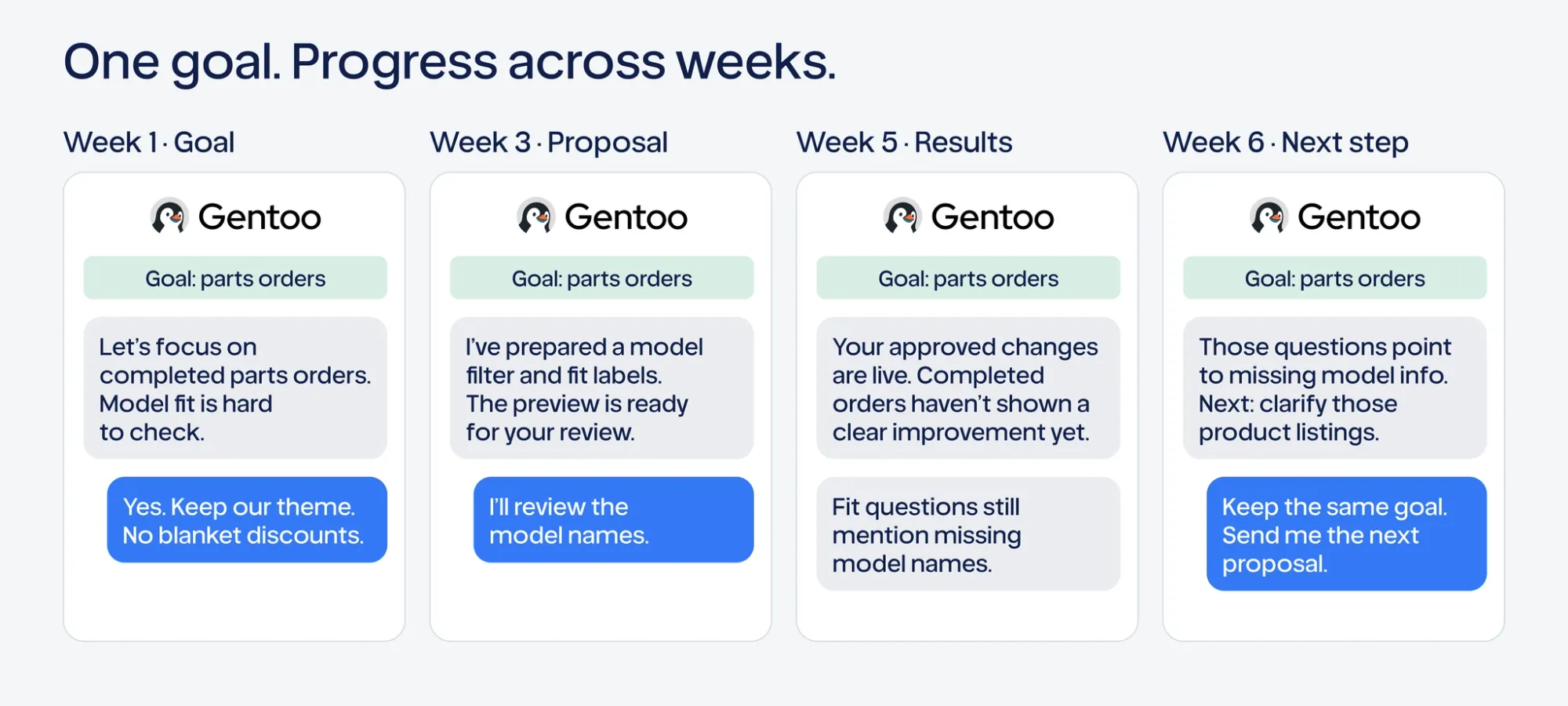
How Gentoo chooses the next Shopify improvement
Gentoo helps identify a growth goal from the store's situation and the merchant's business context, rather than requiring a complete brief before it can help. The merchant confirms the direction and operating limits. Industry trends, competitor context and store evidence inform what deserves attention.
Keep the goal moving across weeks
Gentoo carries the agreed goal, business guidelines, previous work and results across weeks. An audit can inform that work, but a new conversation does not need to restart the diagnosis.
For example, more spare-parts orders without broader discounts could remain the goal while individual actions change. That is an illustrative direction, not a fixed prescription for every store.
Reach out with work ready to review
Gentoo proactively contacts the merchant through iMessage and email when useful work needs attention. It investigates and prepares a proposed solution, instead of leaving the merchant to translate each finding into a sequence of prompts and tasks.
Through iMessage, the merchant can assign work, receive reports and adjust the strategy. They do not have to sit in a chat managing every step; they still provide consequential business context and approve supported work before it goes live.
Let the business outcome change the next decision
Gentoo executes the approved action and measures the relevant business impact, including revenue or orders when they fit the goal. That evidence informs the next action. A completed change is not itself evidence of a better business result.
The Gentoo app listing describes evidence review, previews, requested changes and rollback. Proactive follow-through and fewer prompts do not remove merchant control.
The difference from an audit-only deliverable is the work that continues afterward: carrying the goal, bringing a solution, executing approved work and returning with a result that changes the next priority.
Use the Shopify store optimization guide to review the wider journey, or the CRO framework to plan a focused change.
Find a Shopify improvement that fits your goal and limits. Run Gentoo’s Quick Analyzer to review the top three opportunities it finds in your store and the reasons to consider them.