On this page
Gentoo vs Shopify CRO Agencies and Audit Tools: What Happens After the Audit?
Compare Gentoo, Shopify CRO agencies and audit tools by scope, implementation ownership, approval and measurement. See when each approach fits.

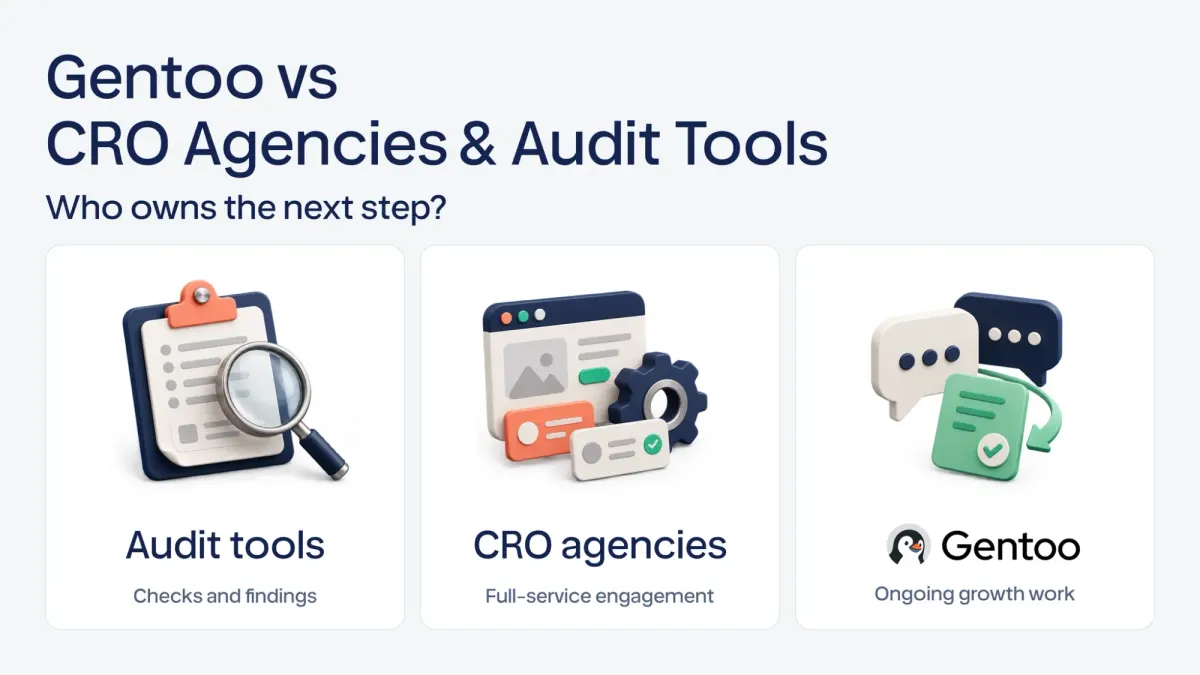
A Shopify CRO agency, an audit tool and Gentoo can all help improve a store, but they can leave very different amounts of work with the merchant. Compare who chooses the next priority, gets the approved work done, reports the result and brings the next decision back to your attention.
A standalone audit delivers findings. A full-service CRO agency may run research, implementation, experiments and reporting. Gentoo works as a Shopify growth partner: it uses store and industry context to choose opportunities, proactively contacts the merchant through iMessage and email, executes approved actions and learns from their business impact.
The question is not just what each provider knows. It is whether you can trust it to move appropriate work forward without having to manage every next step.
Do not confuse an agency with an audit report
Some merchants have paid for several reviews and still do not know what to change first. That is a real operating problem, but it does not describe every CRO agency.
For example, ConversionTeam’s Shopify CRO service describes an audit followed by A/B testing. A service like that should be evaluated as an ongoing engagement, not presented as a report that stops at diagnosis.
Before comparing providers, ask whether the quote includes research, design, development, experiment operation, measurement, and follow-up. Two offers called “CRO” may leave very different amounts of work with the merchant.
What an audit tool can provide
An audit tool can help find broken links, unclear content, performance issues, or missing SEO basics. It can be useful before a launch or as a recurring health check.
Its findings are inputs to a decision. The tool may flag missing product information without knowing which category matters most to the business. Unless the product explicitly includes action and measurement, someone still needs to prioritize the findings, implement the fix, and check the result.
The same caution applies to AI-generated reports. A long list is not proof that the next action is appropriate.
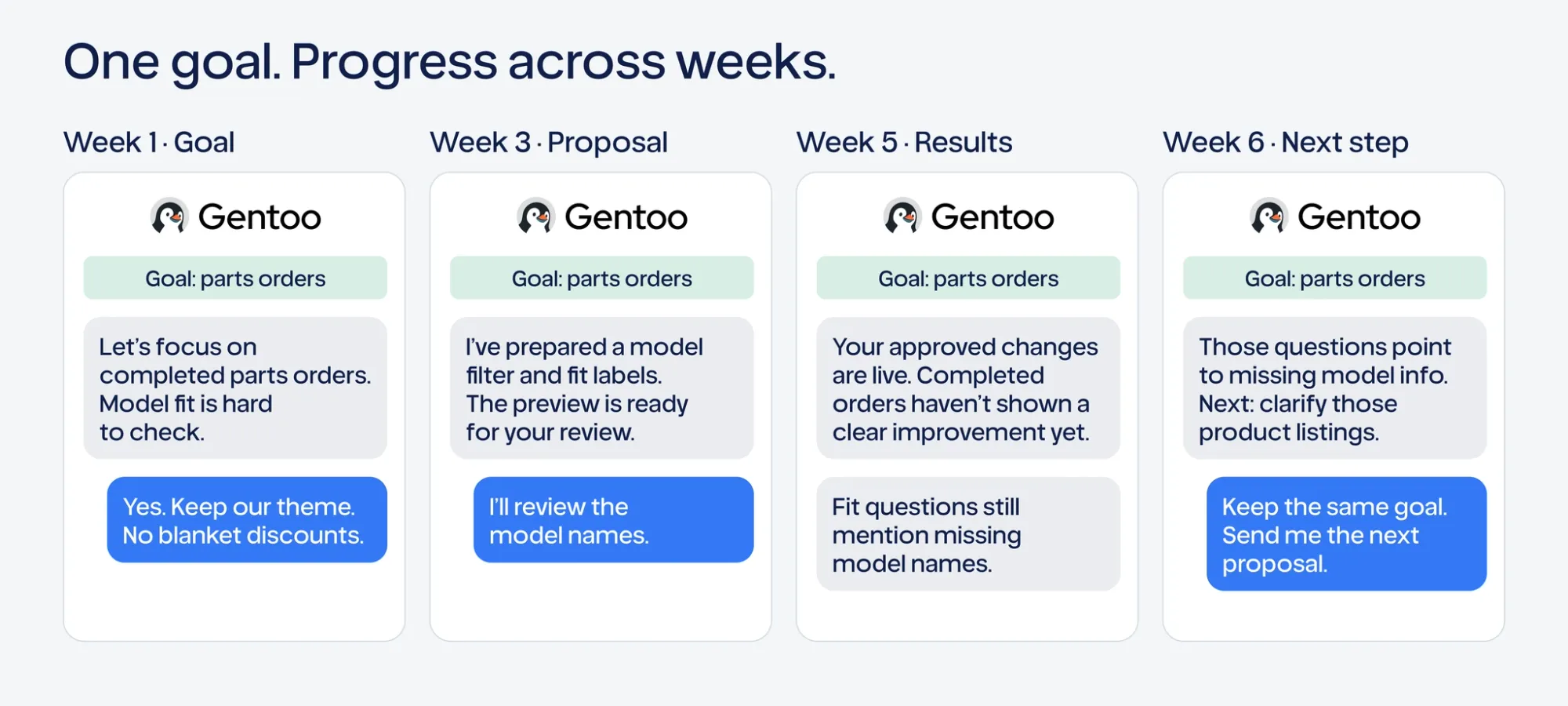
How Gentoo prioritizes Shopify growth opportunities
Gentoo considers store evidence, the merchant's operating limitations and business guidelines, industry trends, competitor context and previous outcomes. A correct finding is useful only if it leads to work worth doing for that business.
Help find the goal and carry it across weeks
The merchant does not need a finished growth brief. Gentoo helps identify and propose a meaningful goal from the store's situation and business context, then works within the direction the merchant confirms.
That goal continues across weeks, along with constraints, previous actions and results. The merchant should not have to reconstruct the project every time another decision is needed.
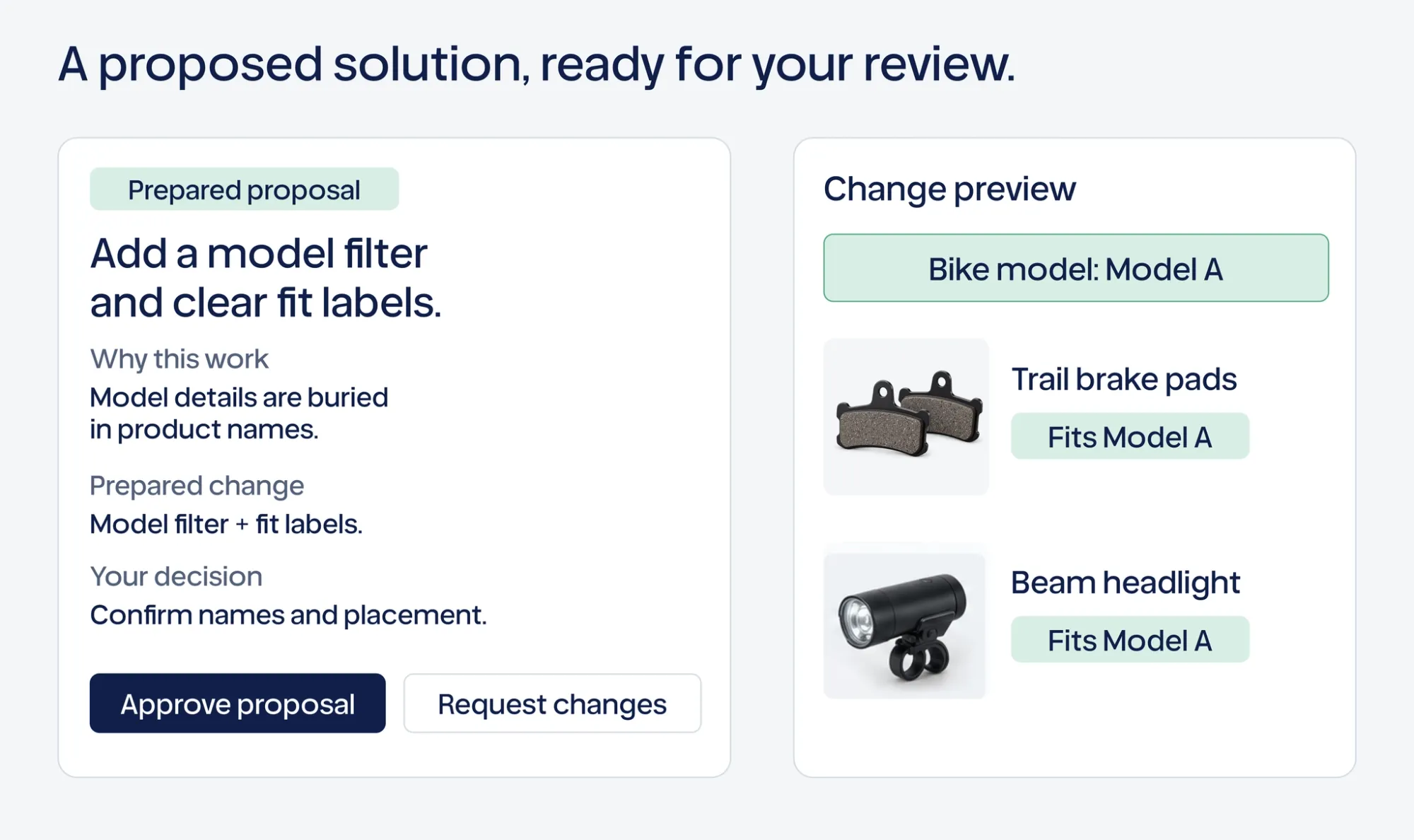
Bring a solution, not another task to manage
Gentoo proactively reaches out through iMessage and email when there is worthwhile work to consider. It investigates and prepares a proposed solution with supporting reasons. Through iMessage, the merchant can give direction, assign work and receive reports without having to steer each analytical and implementation step in a long chat.
Keep merchant control
The Gentoo app listing describes evidence review, change previews, approval, requested revisions and rollback. Gentoo executes supported work after approval. It still needs input where an important business limit or change in direction affects the decision.
Use the result to choose the next action
After execution, Gentoo measures the goal-relevant business impact, including revenue or orders where appropriate. The result changes what deserves attention next. Accepting a recommendation or shipping a change is not proof that it helped.
A full-service agency can also provide ongoing goals, proactive contact and outcome learning. Compare the actual engagement and the effort left with your team, rather than treating these as abilities only software can provide.
Compare ownership across the three options
| Question | Standalone audit tool | Full-service CRO agency | Gentoo |
|---|---|---|---|
| How does work begin? | A scan or review | An agreed research and service scope | The merchant's goal, limitations, guidelines and commercial context |
| Who prioritizes findings? | Usually the merchant or their team | May be included; confirm in the engagement | Gentoo judges opportunities against the goal, business limits and industry context |
| Who implements? | Usually a separate owner | May be included; confirm design and development scope | Gentoo executes approved actions within supported scope |
| How are results assessed? | Reporting depends on the tool | Testing and commercial reporting may be included | Measured outcomes recalibrate future priorities; approval alone is not proof of impact |
| Where is it useful? | A baseline or narrow health check | Specialist research, experiments, or a managed program | Ongoing growth partnership with merchant-specific priorities, approved execution and proactive reporting |
| What informs a decision? | Checks and findings; context depends on the tool | Can include merchant constraints, category research and results; confirm the engagement | Store evidence, merchant limits, industry knowledge and previous business outcomes |
| Who initiates the follow-up? | Alerts and recurring reports depend on the product; findings alone do not establish follow-through | Proactive recommendations, reporting and strategy reviews may be included; confirm scope and communication | Gentoo proactively sends recommendations and reports through iMessage and email |
| How does the merchant direct ongoing work? | Depends on the tool; implementation may need a separate owner | Through the agreed working relationship and communication channels | Assign Gentoo work, receive reports and adjust strategy through iMessage |
| Who keeps the goal moving across weeks? | Usually the merchant or a separate owner; check product scope | An ongoing engagement may include this responsibility; confirm scope | Gentoo helps identify the goal and carries the agreed direction, limits and results into the next decision |
| Who prepares the solution? | Findings may still need an implementation owner | Preparation and execution may be included; confirm the engagement | Gentoo investigates and prepares supported work for approval without step-by-step merchant direction |
These are scope distinctions, not a ranking of every vendor. Check an actual proposal or product workflow before assuming any row applies.
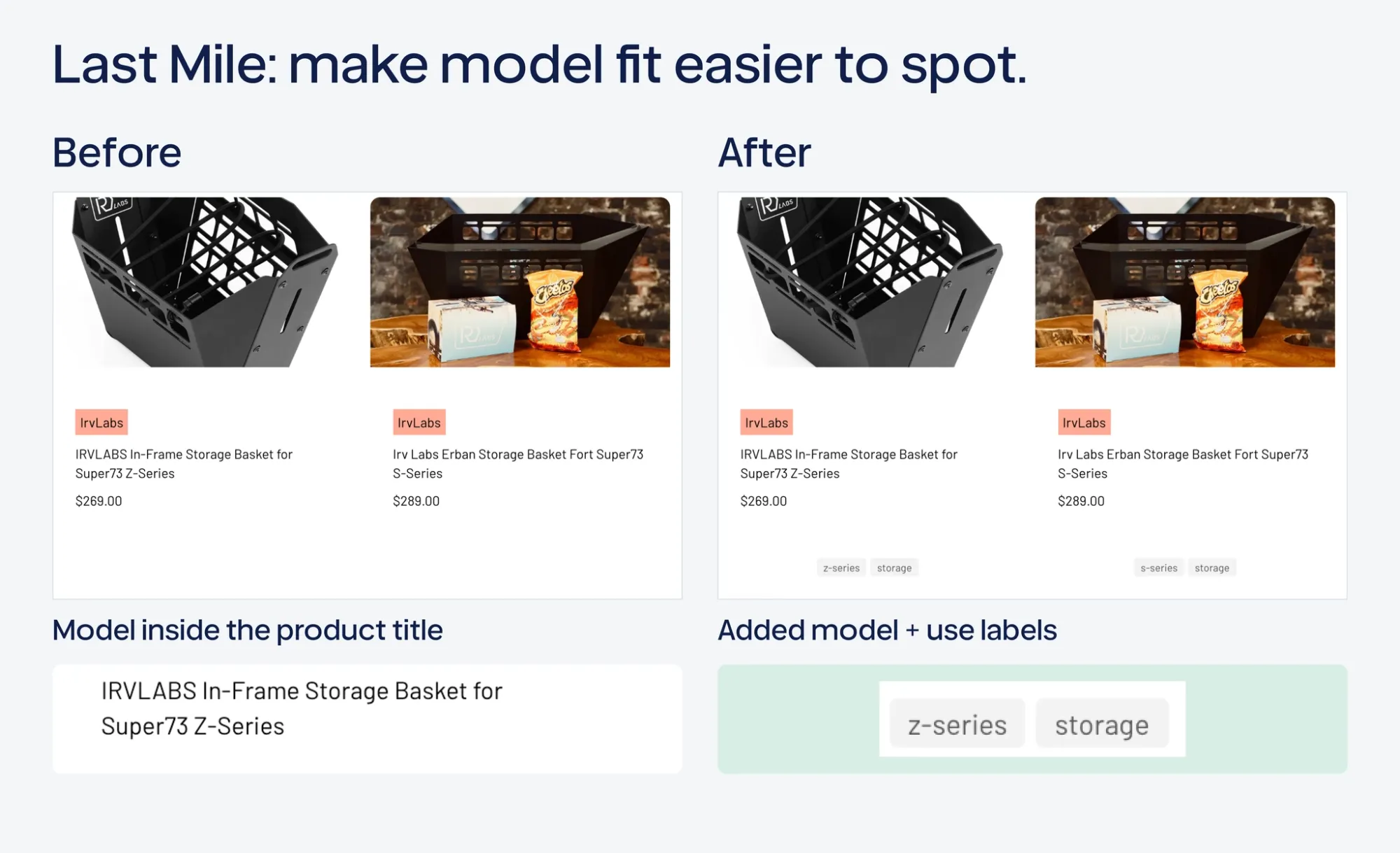
Last Mile: a specific priority instead of a general redesign
At Last Mile SF & Marin, the merchant had heard several possible explanations for the store’s growth problems. Gentoo reviewed sales history and listened to the merchant’s insight. Spare-parts discovery became a priority: shoppers needed help finding relevant parts for their bikes.
Gentoo improved collection filters, product information, and navigation. The published Last Mile case study reports Q2 2026 online revenue up 207%, orders up 116%, and sessions up 48% versus Q1. The period included 16 actions across discovery, SEO, and the path to purchase.
It is not evidence that every audit or agency would have missed the opportunity, nor that one filter caused all the growth. It shows why the priority needed to fit this catalog and this merchant’s goal.
If your store has a similar discovery problem, inspect how shoppers narrow collections and confirm compatibility before commissioning a general redesign.
When to choose an audit tool
Choose a standalone audit when you need a baseline and have someone able to act on the findings. That may be a pre-launch review, a technical check after a theme change, or a narrow question about a set of pages.
Ask for reproducible findings: the affected URL, the problem, the evidence, and the suggested fix. Then assign an owner and a review date. Otherwise the audit becomes another backlog with no outcome.
For that handoff, use the Shopify store optimization guide.
When to choose a CRO agency
An agency can be a good fit when you need specialist research, design, engineering, or someone to operate a testing program. It may also be appropriate for a project requiring substantial coordination across teams.
Check whether the agency has experience with your category, how it handles limited traffic, and what it will do when an experiment is inconclusive. Ask which results it reports and how implementation is approved.
Do not decide on an invented universal price comparison. Compare current quotes, scope, team capacity, and the work left for your merchant team.
When to choose Gentoo
Consider Gentoo when you want a growth partner to bring you worthwhile decisions, carry out supported work after approval and come back with the result. You should not have to identify every task or remember to restart the improvement process yourself.
This can be useful after an audit or alongside an existing development team. Good tools and technical ability do not remove the effort of choosing where to focus, respecting business limits and deciding what the results mean.
A team that already handles those responsibilities well should compare the extra value against its current process. The CRO framework explains the wider work that a growth partner needs to support.
Five questions before buying
- What work is included after the findings are delivered?
- Who approves and implements each change?
- Which metric will show whether the action helped the business?
- What happens when the result is weak or inconclusive?
- Who brings the next priority and result back to us without waiting for us to chase an update?
The answers make a comparison more useful than a feature count or an unsupported promise of uplift.
Choose your next Shopify improvement around your business goal. Run Gentoo’s Quick Analyzer to review the top three opportunities it finds and the reasons to consider them.